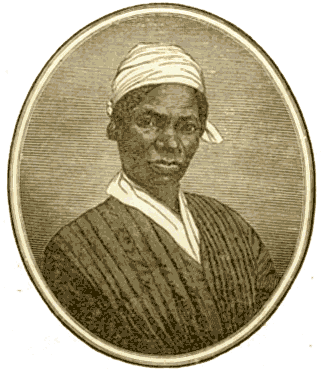
The Life of Sojourner Truth
IMPORTANT DATES
Born 1797 as Isabella Baumfree
Died: November 26, 1883
July 4, 1827. Freed from slavery, although the State of New York granted Freedom in 1817. The state also ecreed that anyone born after 1797 must wait an additonal ten years.
Sued to retrieve her son Peter, who had been sold illegally to a plantation owner in Alabama. In 1828, She became the first black woman to take a white man to court and win.
1851, Delivered her famous “Ain’t I a Woman Speech at Ohio Women’s Rights Convention in Akron


Early years
Truth was one of “ten or twelve” children born to James and Elizabeth Baumfree.James Baumfree was a slave captured from the Gold Coast in modern-day Ghana. Elizabeth Baumfree, also known as Mau-Mau Bet to children who knew her, was the daughter of African slaves from the Coast of Guinea. The Baumfree family were slaves of Colonel Hardenbergh. The Hardenbergh estate was in a hilly area called by the Dutch name Swartekill (just north of present-day Rifton), in the town of Esopus, New York, 95 miles north of New York City.] After the colonel’s death, ownership of the family slaves passed to his son, Charles Hardenbergh.
After the death of Charles Hardenbergh in 1806, Truth, known as Belle, was sold at an auction. She was about 9 years old and was included with a flock of sheep for $100 to John Neely, near Kingston, New York. Until she was sold, Truth spoke only Dutch.
She suffered many hardships at the hands of Neely, whom she later described as cruel and harsh and who once beat her with a bundle of rods. Truth previously said Neely beat her daily. Neely sold her in 1808, for $105, to Martinus Schryver of Port Ewen, a tavern keeper, who owned her for 18 months. Schryver sold her in 1810, for $175, to John Dumont of West Park, New York. Although this fourth owner was kindly disposed toward her, his wife found numerous ways to harass Truth and make her life more difficult.
Around 1815, Truth met and fell in love with a slave named Robert from a neighboring farm. Robert’s owner (Catlin) forbade the relationship; he did not want his slave to have children with a slave he did not own, because he would not own the children. Robert was savagely beaten and Truth never saw him again. Later, he died from the aforementioned injuries. In 1817, Truth was forced by Dumont to marry an older slave named Thomas. She had five children: Diana (1815), fathered by Robert; and Thomas who died shortly after birth, Peter (1821), Elizabeth (1825), and Sophia (ca. 1826), fathered by Thomas.
Freedom
The state of New York began, in 1799, to legislate the abolition of slavery, although the process of emancipating New York slaves was not complete until July 4, 1827. Dumont had promised to grant Truth her freedom a year before the state emancipation, “if she would do well and be faithful.” However, he changed his mind, claiming a hand injury had made her less productive. She was infuriated but continued working, spinning 100 pounds of wool, to satisfy her sense of obligation to him.
Late in 1826, Truth escaped to freedom with her infant daughter, Sophia. She had to leave her other children behind because they were not legally freed in the emancipation order until they had served as bound servants into their twenties.
She later said:
“I did not run off, for I thought that wicked, but I walked off, believing that to be all right.”
She found her way to the home of Isaac and Maria Van Wagener, who took her and her baby in. Isaac offered to buy her services for the remainder of the year (until the state’s emancipation took effect), which Dumont accepted for $20. She lived there until the New York State Emancipation Act was approved a year later.
Truth learned that her son Peter, then five years old, had been sold illegally by Dumont to an owner in Alabama. With the help of the Van Wageners, she took the issue to court and, after months of legal proceedings, got back her son, who had been abused by his new owner. Truth became one of the first black women to go to court against a white man and win the case.
Truth had a life-changing religious experience during her stay with the Van Wageners, and became a devout Christian. In 1829 she moved with her son Peter to New York City, where she worked as a housekeeper for Elijah Pierson, a Christian Evangelist. In 1832, she met Robert Matthews, also known as Matthias Kingdom or Prophet Matthias, and went to work for him as a housekeeper. In a bizarre twist of fate, Elijah Pierson died, and Robert Matthews and Truth were accused of stealing from and poisoning him. Both were acquitted and Robert Matthews moved west.
In 1839, Truth’s son Peter took a job on a whaling ship called the Zone of Nantucket. From 1840 to 1841, she received three letters from him, though in his third letter he told her he had sent five. When the ship returned to port in 1842, Peter was not on board and Truth never heard from him again.
The Truth Calls Me
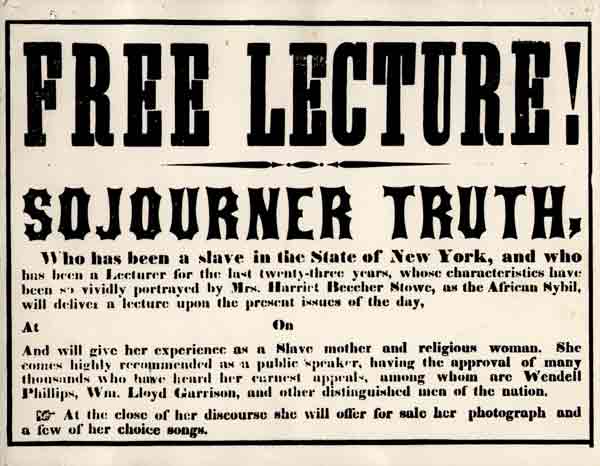
On June 1, 1843, Truth changed her name to Sojourner Truth and told her friends, “The Spirit calls me, and I must go.” She became a Methodist, and left to make her way traveling and preaching about the abolition of slavery. In 1844, she joined the Northampton Association of Education and Industry in Northampton, Massachusetts. Founded by abolitionists, the organization supported women’s rights and religious tolerance as well as pacifism. There were 210 members and they lived on 500 acres (2.0 km2), raising livestock, running a sawmill, a gristmill, and a silk factory. While there, Truth met William Lloyd Garrison, Frederick Douglass, and David Ruggles. In 1846, the group disbanded, unable to support itself. In 1847, she went to work as a housekeeper for George Benson, the brother-in-law of William Lloyd Garrison. In 1849, she visited John Dumont before he moved west.
Truth started dictating her memoirs to her friend Olive Gilbert, and in 1850 William Lloyd Garrison privately published her book, The Narrative of Sojourner Truth: A Northern Slave. That same year, she purchased a home in Northampton for $300, and spoke at the first National Women’s Rights Convention in Worcester, Massachusetts.
Ain’t I a Woman?
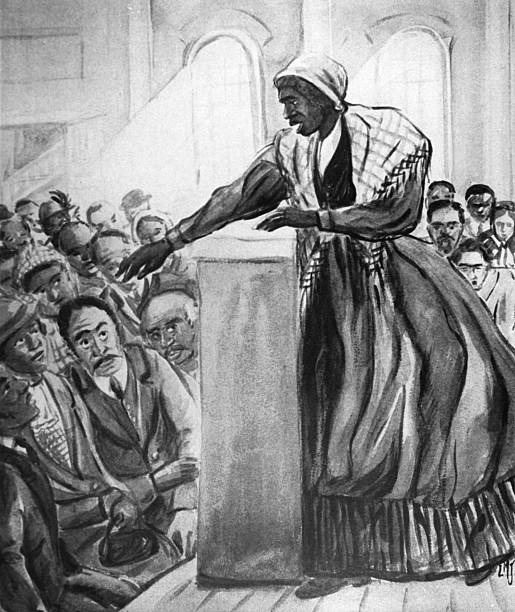
In 1851, Truth left Northampton to join George Thompson, an abolitionist, and speaker. In May, she attended the Ohio Women’s Rights Convention in Akron, Ohio where she delivered her famous extemporaneous speech on racial inequalities, later known as “Ain’t I a Woman.”
NOTE: This information was taken from Wikipedia, the free encyclopedia. Go here to read the entire history.